Every device that ships with MAGDA, ready to explore — and try directly in your browser.
MAGDA’s effects are written in FAUST and compiled to native code for the desktop. Because FAUST can target WebAssembly too, the very same DSP can run right here in the browser.
So these aren’t demos or approximations: you’re running the actual MAGDA devices.
Press Play on any card to try one. Effects process a drum loop, instruments give you a playable keyboard, and drum devices come with pads and a beat to get you started.
Instruments, MIDI processors and tools for writing your own DSP complete the collection.
Source material
Playing through the effects: Drums 120
The effects run a drum loop by default. Search Freesound to hear them against something of your own choosing instead — a vocal, a guitar, a field recording. CC0 results only.
Part one
The built-in library
The devices MAGDA ships as devices: compiled into the app, with a spec, an inspector and a place in the FX browser. Nothing to install, nothing to load.
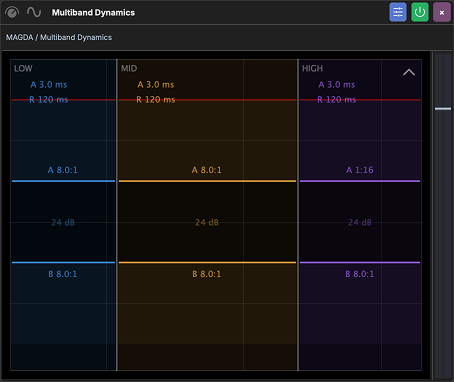
Native 3-band dynamics processor with independent lower and upper threshold regions per band. Ratios above 1:1 compress toward the active threshold; ratios below 1:1 expand away from it.
Limiter
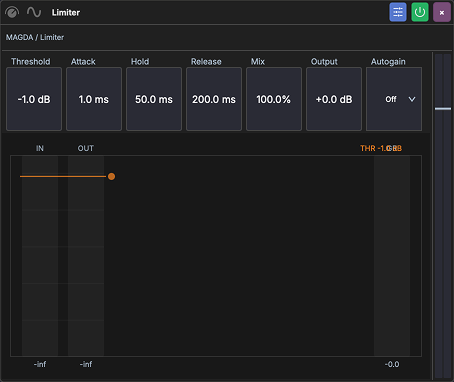
Native stereo lookahead limiter and autonormalizer. Threshold drives the signal into a fixed 0 dB ceiling, so lowering it pushes harder into the limiter for loudness while the output stays pinned to the ceiling. Attack and Release shape how gain recovers after a peak, and Output is a post-limiter trim. Transparent peak control with automatic normalization to the ceiling.
Gate
Compiled Faust stereo gate / downward expander with a linked peak detector. Threshold sets where the gate opens; Ratio shapes the slope; Range bounds the deepest cut. Attack and Release shape the envelope; Mix blends the gated signal back against dry for parallel gating.
Brouns FBFF compressor with its character controls exposed. FBFF morphs the detector between feedback and feedforward; Detector and Style pick what it listens to and how hard it leans. Threshold, Ratio, Knee, Attack and Release do the compressing, Link ties the channels, and Autogain, Makeup, Mix and Output set what leaves.
Tonal shaping, corrective filtering, multi-engine virtual analog filter.
EQ
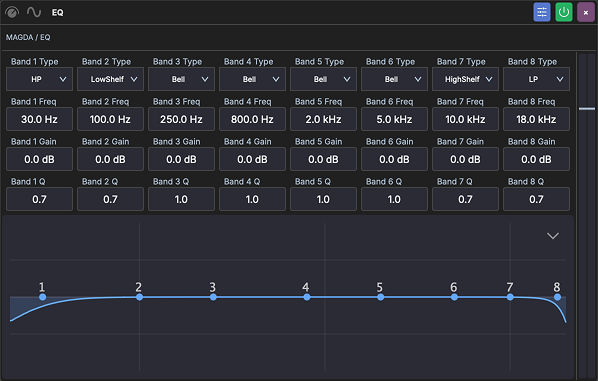
Compiled Faust 8-band parametric equaliser. Per-band Type selects HP, LowShelf, Bell, HighShelf, LP, or Notch. All six filter shapes are instantiated in parallel per band, so Type switching is glitch-free at audio rate. Each band exposes Freq, Gain, Q; Output trims the final sum.
Filter
Compiled Faust multimode filter. SVF: clean 2-pole LP/BP/HP/Notch for precise shaping. Ladder: classic 4-pole low-pass with driven resonance. Korg 35: MS-style LP/HP character with sharper analog bite. Oberheim: SEM-style LP/BP/HP/Notch with broad musical sweeps. Sallen-Key: smooth 2nd-order LP/BP/HP response. Diode: resonant 4-pole diode ladder with input drive. Warning: high resonance can create very loud peaks or self-oscillation. Keep monitoring levels conservative to protect speakers and ears.
Compiled Faust stereo digital delay with fractional-sample interpolation. Time spans 1 ms to 2 s; Sync locks to musical Division. Feedback recirculates with Tone shaping the regen path. Cross routes feedback across channels for ping-pong patterns.
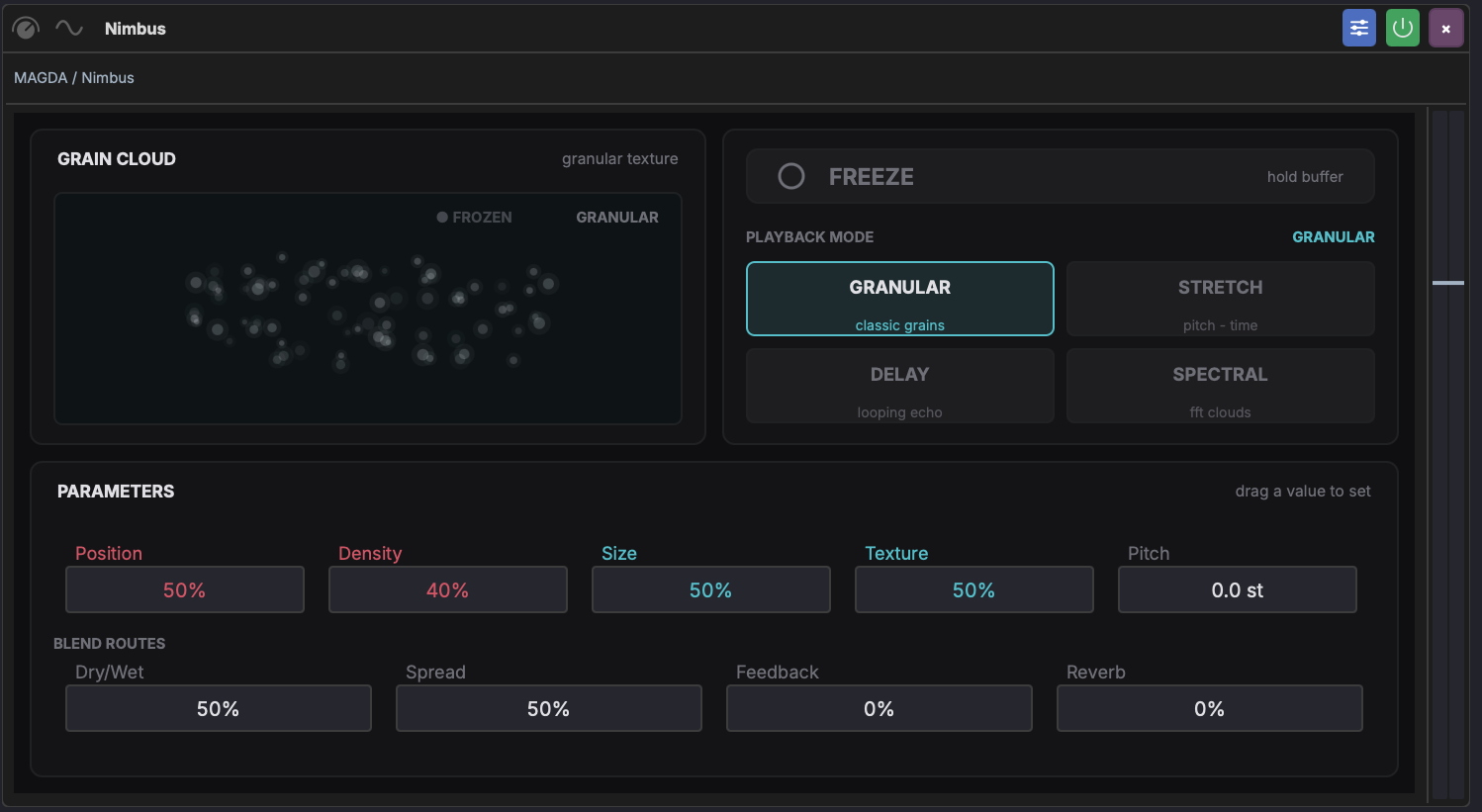
Compiled Faust granular delay. A feedback delay line is read through a 4-voice Hann-windowed grain bank with 25% overlap. Pitch shifts via per-grain read-offset drift; Spray jitters the per-grain position. Time spans the base delay, locking to musical Division when Sync is on. Feedback recirculates through the grain bank; Mix blends wet against dry.
Compiled Faust stereo chorus with one to three modulated voices per channel. Voices share a single LFO with per-voice phase offsets for spread. Rate runs free in Hz or locks to tempo Division. Depth, Feedback, Mix and Width complete the controls.
Compiled Faust stereo flanger. Short modulated delay per channel (~3 ms +/- 2.5 ms) with a heavy feedback loop for the classic comb-filter sweep. Rate runs free in Hz or locks to tempo Division; Depth, Feedback, Mix and Width round out the controls.
Compiled Faust stereo phaser with a sweeping notch comb. Stages selects 2, 4, 6, or 8 notches; all four counts are instantiated in parallel, so switching is glitch-free. Rate and Depth drive the sweep; Feedback intensifies the resonance; Min Hz and Max Hz bound the sweep window. Mix blends wet against dry.
Compiled Faust modulation effect with a shared LFO. Tremolo: amplitude modulation, equal on both channels. Vibrato: pitch modulation via short modulated delay. Autopan: equal-power pan between L and R. All three mode bodies run in parallel for glitch-free switching. LFO Shape selects Sine, Triangle, Square or Sample-and-hold; Rate runs free in Hz or locks to tempo Division.
Compiled Faust stereo ring modulator. Multiplies the input by an internal carrier from 1 Hz (slow tremolo) to 5 kHz (metallic clang). Sine: pure tonal carrier, cleanest sideband structure. Triangle: softer overtone series than square. Square: rich odd-harmonic spectrum, aggressive sideband stack. Rate runs free in Hz or locks to tempo Division. Width offsets the carrier phase per channel; Mix blends wet against dry.
Compiled Faust waveshaper with six selectable curves. Tanh: smooth hyperbolic, the classic warm saturation. Soft: gentle polynomial knee with a rolled-off top. Hard: instant clip ceiling for square-edged distortion. Fold: wavefolder, peaks reflect back for metallic overtones. Tube: asymmetric curve (1.4x positive, 1.0x negative) for valve-style even harmonics. Tape: tanh with an odd-order compression term, tape-style headroom. Drive pushes the input, Bias shifts the operating point, Tone tilts the post-shape EQ, Mix blends dry.
Compiled Faust antialiased clipper with five selectable static curves from the aa.* ADAA library. Hard: brickwall clip ceiling. Soft: quadratic knee for warmer breakup. Tanh: hyperbolic tube-style curve. Hyperbolic: smooth rational saturation. Sine: sin(atan(x)) for asymmetric, harmonically rich clipping. All five are instantiated in parallel for glitch-free Mode switching. Drive pushes the input into the curve; Output trims the result.
Compiled Faust lo-fi bitcrusher. Rate reduces sample rate via dual sample-and-hold (100 Hz to 48 kHz). Bits applies mid-tread quantization from 1 to 16 bits. Drive shifts the quantization landing point for crunchier or softer attacks. Tone tames aliasing with a post-crush low-pass. Mix and Output blend and trim.
Compiled Faust texture generator. Ring-modulates the input with a tone or filtered-noise carrier for Erosion-style grit. Noise: shared mono bandpass-filtered noise on both channels. Wide Noise: decorrelated stereo noise for spatial texture. Sine: tonal sine carrier at the Frequency knob for metallic ring-mod. Frequency is the carrier centre (or BPF centre in the noise modes); Width sets the bandpass Q; Amount blends the wet against the dry.
Compiled Faust pitch shifter with three selectable engines. Shifter: single voice, full plus/minus 24 semitones. Detuner: two voices hard-panned L/R for chorus-style thickening. Harmonizer: shifted voice summed with dry at a chosen interval. All three use ef.transpose; transient smear and grain are by design.
Compiled Faust stereo single-sideband frequency shifter. Shifts the entire spectrum by a fixed Hz offset using a Bode design: a Niemitalo Hilbert transformer (~80 dB image rejection) is complex-multiplied with a phasor at the Shift frequency. Unlike a pitch shifter the harmonic ratios are not preserved, producing inharmonic, metallic timbres. Feedback recirculates for resonant artefacts; Spread detunes the channels by up to 25 Hz for chorus-style stereo.
Compiled Faust stereo widener with three selectable engines. Dimension: Roland Dimension D-style anti-phase modulated delays. Haas: short fixed delay on one channel, classic psychoacoustic cue. M/S: pure mid-side side-channel gain, no time smear.
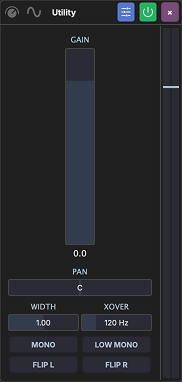
Stereo utility stage. Gain trims level; Pan shifts the stereo image; Width adjusts the M/S spread. Mono folds the signal down for compatibility checks; Low Mono sums only the bass below the Low Mono Freq cutoff, tightening sub content while preserving stereo highs. Flip L / Flip R invert per-channel polarity for phase tweaks.
Test Tone
Simple tone generator for calibration, routing checks, and utility signals.
Analysis
Metering and visualisation: oscilloscope, spectrum, loudness.
Oscilloscope
Live waveform display that triggers on a zero crossing so the trace holds still instead of scrolling. Adjustable timebase from a few milliseconds to a few seconds, selectable trace colour, dBFS reference lines. Transparent pass-through; insert it anywhere in a chain, in the post-FX area, or pop it out into its own always-on-top window. Also appears as a mini view on the mixer strips.
Spectrum Analyzer
Windowed FFT magnitude plot on a log-frequency axis, with peak hold, adjustable slope tilt, smoothing speed, and FFT size. The Overlay selector draws another track's spectrum on the same display and shades the frequency ranges where the two tracks mask each other, with intensity following the severity of the clash. Transparent pass-through, mixer mini view, pop-out window.
Levels
Loudness and stereo meter built on BS.1770: integrated LUFS, oversampled true peak (dBTP), PLR and PSR dynamics ratios, stereo correlation, and width. Transparent pass-through that only spends CPU while its meter is visible. Drop it on the master to know where the mix stands.
Instruments
Synthesis, sampling, drum chains.
4OSC Synth
Four-oscillator subtractive instrument from Tracktion Engine, with per-oscillator unison, MAGDA's modulation envelopes / LFOs, macro-friendly controls and the standard preset workflow.
Sampler
Single-zone sample playback instrument with amplitude envelope, pitch, start / end positions, and looping. Drop a sample, play across the keyboard.
Drum Grid
Pad-based drum instrument. Each pad holds its own sample plus an effect chain, so kits build up incrementally. The clip view is a step grid; shift-drag stamps repeats with the dedicated repeater cursor.
Poly Synth
Compiled Faust polyphonic synth: four detunable oscillators (sine/saw/square/triangle) into a multimode filter with its own envelope, plus an ADSR amp envelope. 16-voice, MIDI-driven.
MAGDA /Poly Synth
Loading the device…
or play it yourself, with the mouse or the A to J keys, Z and X to shift octave
Four-operator FM synth with a full 4x4 modulation matrix: every operator (Sine/Tri/Saw/Square/Noise) can phase-modulate any operator, the diagonal is self-feedback. Per-op ratio/level + amp ADSR. 16-voice, MIDI-driven.
MAGDA /FM0
Loading the device…
or play it yourself, with the mouse or the A to J keys, Z and X to shift octave
Synthetic kick in three layers: a Transient (pitched sine sweep), a Body (low pitch-snap sine into a saturator) that auto-ducks under the transient, and a noise Click. Knob-tuned, MIDI-gated; drop it on a Drum Grid pad or play it standalone.
MAGDA /Kick
Loading the device…
four to the floor, or hit the pads yourself, with the mouse or the 1 to 4 keys
Synthetic snare in three layers: a noise Transient (stick crack), a tuned pitch-snap Body that auto-ducks under the transient, and a resonant-high-passed noise Rattle/tail with drive. Knob-tuned, MIDI-gated; drop it on a Drum Grid pad or play it standalone.
MAGDA /Snare
Loading the device…
four to the floor, or hit the pads yourself, with the mouse or the 1 to 4 keys
Synthetic hi-hat in two layers: a metallic Ring (inharmonic additive partials with a Spread/dissonance control) and a high-passed Noise sizzle, each with its own level and decay. Short decays = closed, long = open. Knob-tuned, MIDI-gated; drop it on a Drum Grid pad or play it standalone.
MAGDA /Hat
Loading the device…
four to the floor, or hit the pads yourself, with the mouse or the 1 to 4 keys
Synthetic tom in two layers: a tuned sine Body with a downward pitch sweep and a high-passed Noise stick/skin attack, each with its own level and decay. Knob-tuned, MIDI-gated; drop it on a Drum Grid pad or play it standalone.
MAGDA /Tom
Loading the device…
four to the floor, or hit the pads yourself, with the mouse or the 1 to 4 keys
Synthetic clap: one band-passed noise source shaped by a fast three-triangle envelope (the hand-clap flam), over a diffuse tail. Knob-tuned, MIDI-gated; drop it on a Drum Grid pad or play it standalone.
MAGDA /Clap
Loading the device…
four to the floor, or hit the pads yourself, with the mouse or the 1 to 4 keys
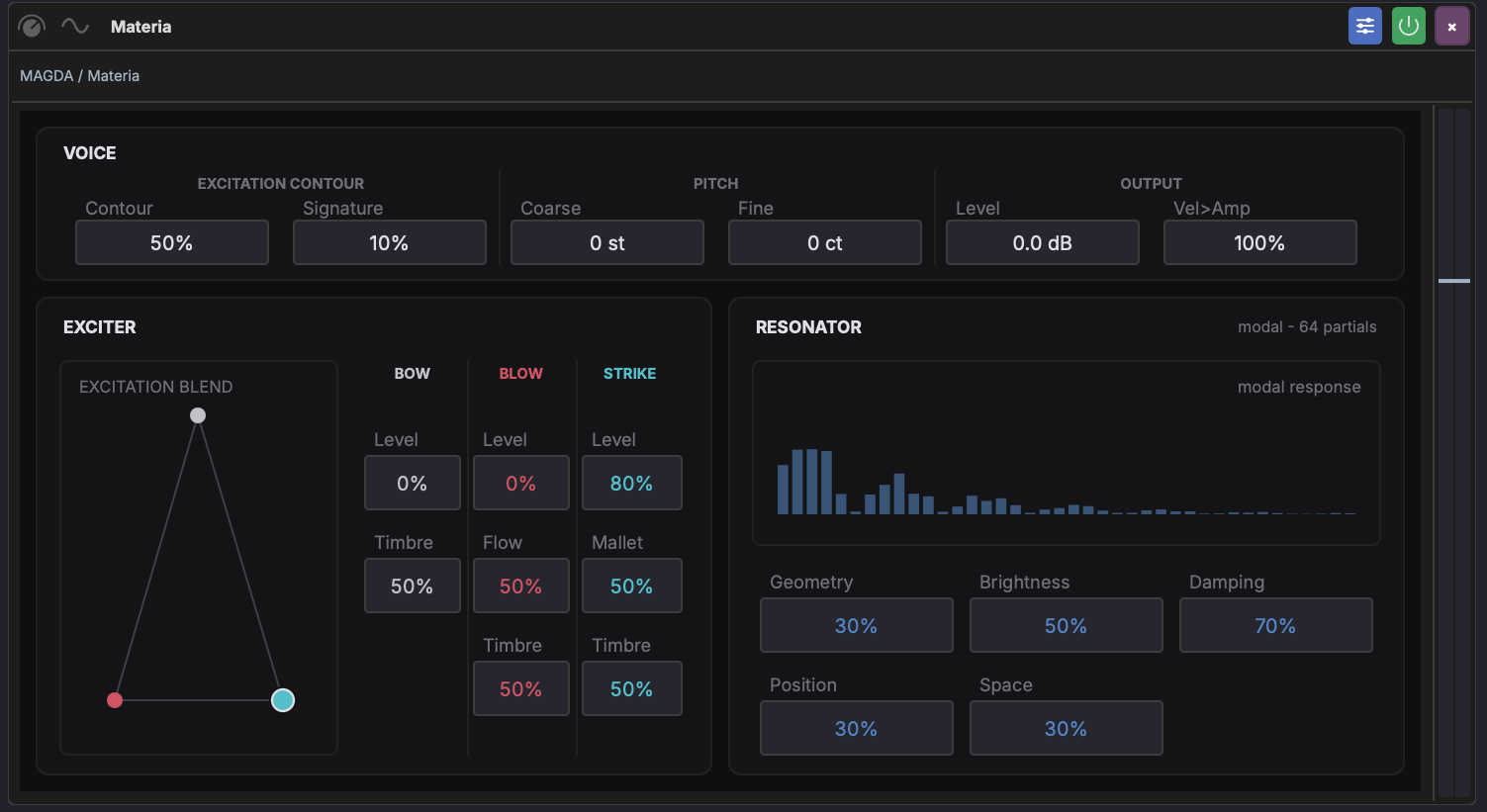
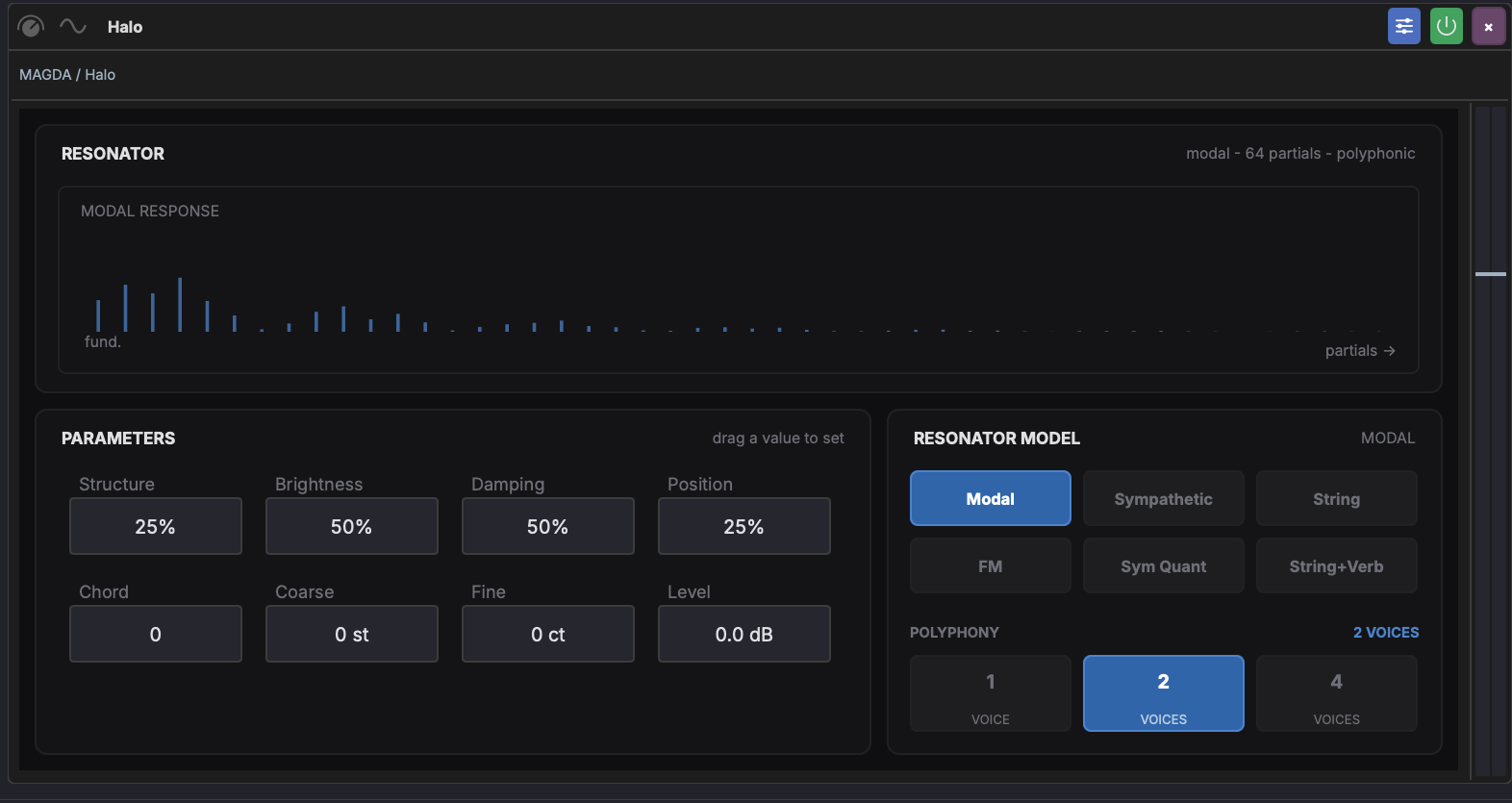
Struck modal marimba: a tuned tone-bar-and-tube physical model driven by a strike exciter (Position / Tone / Sharpness). Follows the played note; modal decay is intrinsic to the model, so there is no damping knob.
MAGDA /Marimba
Loading the device…
or play it yourself, with the mouse or the A to J keys, Z and X to shift octave
Struck modal djembe: a hand-drum membrane physical model driven by a strike exciter (Position / Sharpness). Follows the played note; modal decay is intrinsic to the model, so there is no damping knob.
MAGDA /Djembe
Loading the device…
or play it yourself, with the mouse or the A to J keys, Z and X to shift octave
Struck modal bell: a church-bell physical model driven by a strike exciter (Position / Tone / Sharpness). Fixed-pitch, so the played note only triggers it. Modal decay is intrinsic to the model, so there is no damping knob.
MAGDA /Bell
Loading the device…
four to the floor, or hit the pads yourself, with the mouse or the 1 to 4 keys
MIDI processor for chord generation, voicing, and harmonic transforms. Drop into any MIDI chain ahead of an instrument.
Arpeggiator
MIDI arpeggiator for rhythmic note patterns and held-note motion. Pattern, rate, octave range, gate.
Step Sequencer
MIDI step sequencer for pattern-driven notes and rhythmic control. Per-step note, velocity, gate, with shareable patterns.
Experimental
Write your own DSP inside the app.
Faust
Scratchpad for writing your own DSP in FAUST from inside MAGDA. Drop a .dsp file or vibe-code one via the device's AI panel; the model writes the FAUST and the device loads it. Runs through the FAUST interpreter, so CPU is much higher than the built-in devices. A JIT compiler is the plan for the next release.
Part two
FAUST source, running in the Faust device
These are not compiled devices — they are .dsp files that the Faust device above loads while MAGDA is running. Open one, read it, change a line, hear the change. They ship in the same download.
The first few are deliberately small, kept as worked examples of what a Faust device looks like. The rest came from the community, and each card says who wrote it.
Drive
The smallest effect MAGDA ships, kept as a working example of a Faust device: Drive into a lowpass, with an output trim. Stereo.
Two or three detuned saws driven through two notch-and-clip chains, over a clean sine sub. The beating between the outer saws is the Reese it starts from; the notches carve it hollow and the clippers give it teeth.
MAGDA /Neuro Logical
Loading the device…
or play it yourself, with the mouse or the A to J keys, Z and X to shift octave
The smallest instrument MAGDA ships, kept as a working example of a Faust device: a detuned saw pair and a sine sub through a resonant lowpass, under an attack-release envelope.
MAGDA /Simple Synth
Loading the device…
or play it yourself, with the mouse or the A to J keys, Z and X to shift octave
Host-synced beat repeater. Engage captures the incoming bar and loops a Division of it, from the whole bar down to the fastest repeats, with micro-fades scaled to the window so the high-speed modes do not drop audio. Dry/Wet blends the repeat against the signal it came from.
A parallel glitch matrix, after dblue Glitch 2. Stutter-freeze, bitcrusher, ring mod, flanger, phaser and tape stop each fire on their own Probability against a shared Master Speed clock, running beside one another rather than in a chain, so they can land together. A master hard clipper catches what that costs; Master Mix blends the matrix against dry.
Rain as a physical model rather than a noise bed: pitch-tracked resonant comb filters make the hollow river splashes, and a separate stochastic engine makes the puddles. Intensity sets how hard it is falling; Tin Roof Impacts, River/Deep Splashes, Puddle Splashes and Drops + Reverb balance what it is falling on.
Real-time phrase reverser. Engage runs the signal into a rolling buffer and reads it back out backwards, and Window sets how much it reverses at a time, from a 1/8 glitch to a whole bar. It runs fully wet; Dry/Wet blends the clean signal back in.
Transient designer with independent attack and sustain detectors, so shaping one does not move the other. Each has its own Boost/Cut; Speed sets how fast the attack is caught and Release how long the sustain is held. Trim and Master Mix set the output.
Vintage sampler emulation. Model picks the machine, and with it the downsampling, the pitch-dependent clock jitter and ringing, and a 10-bit or 12-bit quantisation scheme cut to match. Lo-Fi FX Gain drives the character independently of the clean pass, and the Master Hard Clipper catches what that costs.
Vinyl texture and the pitch instability that comes with it. Engage 45 RPM runs the wow engine and Warp Depth sets how far the pitch drifts; Crackle Volume sets the pops and micro-jitter over the top.
Eight-frame morphing wavetable wavefolder. Base Frame picks where in the eight harmonic frames it sits and Input Morph Depth sweeps through them; Drive folds. DC Symmetry offsets the fold, Cutoff and Resonance filter what comes out of it, and Re-Roll Chaos Seeds redraws the frames outright. Master Mix and Master Volume set the output.